
Spalding County Criminal Docket Searches
Begin with the court named on the accusation, indictment, citation, warrant notice, or hearing notice. Participating Superior and State Court cases can be searched in re:SearchGA. Its official guide describes separate Cases and Hearings modes, an Advanced control, sorting by filed date or case number, and case details for parties, lawyers, judges, filings, and hearings. Access requires an account, and a public index hit does not mean each document image is free or open.
Keep the full party name, court, case number, filed date, and next setting close at hand. A State Court citation may also appear in the county's Tyler payment portal, but that result is tailored to tickets and payment. It may not be the complete register. A missing result can reflect the wrong court, posting delay, spelling, restricted access, or a sealed record.
- Read the source notice and identify the court before searching.
- Use the case number first, or enter the full party name in re:SearchGA.
- Match the court, case type, and filed date before opening a result.
- Review the charge, settings, plea, judgment, and later probation events separately.
- Ask the proper clerk for an official or certified copy when needed.
Spalding Felonies Start in Superior
Felony cases belong in Spalding County Superior Court, part of the four-county Griffin Judicial Circuit. Misdemeanors, ordinary county traffic cases, and county ordinance matters commonly belong in State Court. Magistrate Court handles criminal and search warrants, individual warrant applications, and pre-warrant hearings. Griffin city citations can remain in Griffin Municipal Court. Federal indictments use the Northern District of Georgia, not a Georgia county portal.
Quick answer: The issuing agency does not decide the docket lane. A sheriff's deputy or state trooper may issue a citation that is filed in State Court. Read the named court and clerk's case number.
This division prevents a common dead end. Searching only a traffic payment page will not locate every felony, warrant, municipal charge, or federal matter. The county's court directory lists the separate offices when the document heading is unclear.
Criminal Dockets: What They Show
A criminal docket is a dated procedural record. It can identify the case, parties, lawyers, judicial officers, charge filings, hearing settings, orders, and final status. The visible fields and document images differ by court, case age, security level, and user role. Treat a docket label as an index entry until the underlying filing or clerk confirms its meaning.
| Case number | The court's unique identifier, which should be copied exactly, such as court-assigned number. |
|---|---|
| Charge filing | An accusation, indictment, citation, or amended filing. It states an allegation, not a conviction. |
| Hearing setting | An arraignment, preliminary hearing, pretrial setting, trial, or later reset. |
| Plea and orders | Separate entries may record a plea, bond ruling, motion decision, or sentence. |
| Disposition | The outcome of a count or case, which may require reading later probation or revocation entries. |
The official re:SearchGA interface illustrates the case and hearing search used for participating courts.
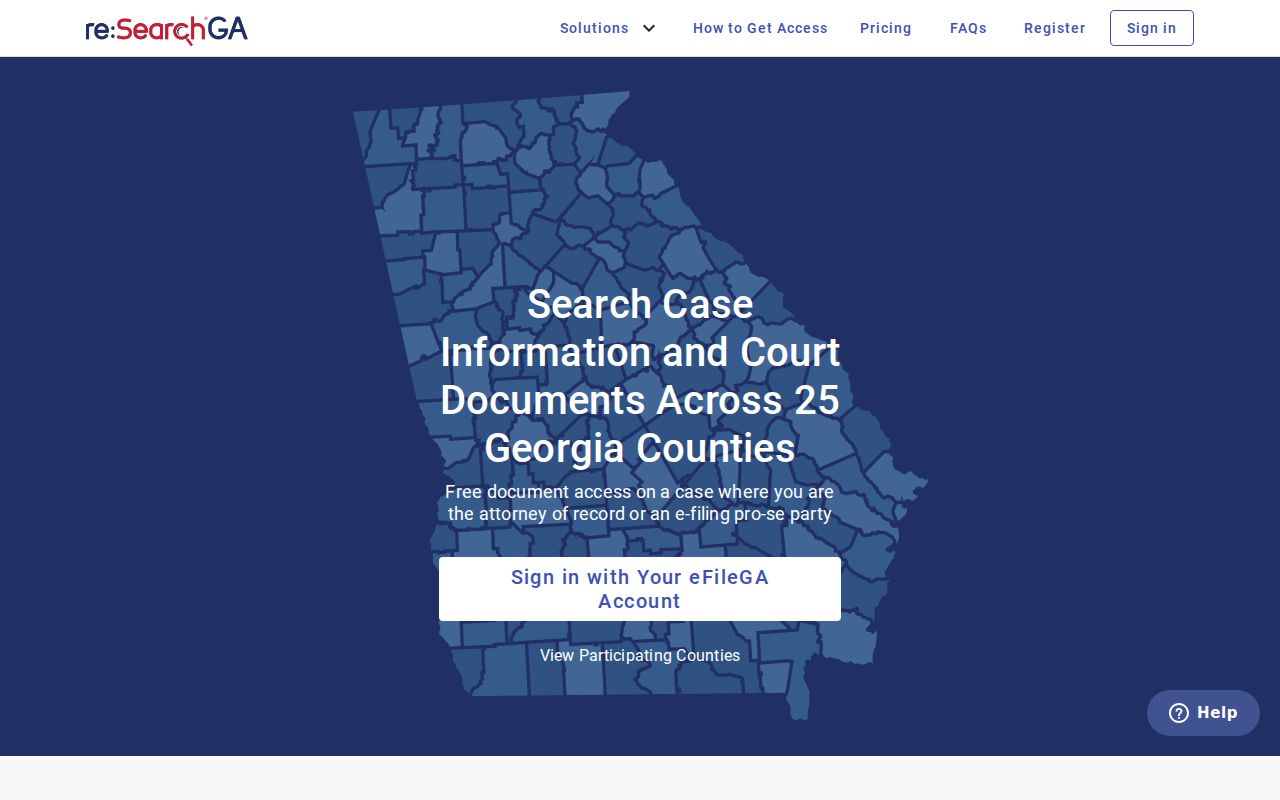
The portal view reinforces why the case summary, hearing list, and filing images must be read as related but distinct parts of the court record.
Spalding Bond Is Not Disposition
Several terms on a criminal register sound final when they are not. Bond concerns release or security. An arraignment is the stage at which charges are addressed and a plea may be entered. A preliminary hearing tests a limited issue and is not a trial. An accusation or indictment states charges. None of those entries alone proves guilt or resolves all counts.
- Accusation
- A formal charging document often used in State Court.
- Indictment
- A grand-jury charging instrument commonly associated with felony proceedings.
- Continuance
- An order moving a scheduled matter to a later date.
- Nolle prosequi
- A prosecutor's formal decision not to pursue a charge at that time.
- Disposition
- The recorded outcome of a charge or case.
Read each count and date. A later amended charge, sentence, probation action, or revocation can change the full picture. The register is not a transcript, and it does not narrate the proof heard in court.
Criminal Case Stages on the Docket
A case usually begins when a charging instrument is filed. The register then records scheduled events and filed decisions. An arraignment may be followed by motions, pretrial settings, plea proceedings, or trial. The sequence is not identical in every matter. A reset changes the date, while a dismissal or judgment addresses an outcome. Later sentencing, probation, or revocation events can extend the docket after the main charge is resolved.
Docket flow: Charge Filed › Arraignment › Pretrial Settings › Plea or Trial › Disposition
Use the most recent order or notice for the next action. A filing date is not a hearing date. Likewise, a payment screen is not a complete case history. When a docket and written notice conflict, contact the clerk before the scheduled setting.
Spalding Warrant and Missed-Date Routes
Questions about a criminal or search warrant belong with Magistrate criminal staff at Spalding County Magistrate Court or the proper law-enforcement custodian. A blank ticket search does not clear a warrant. Arrest, jail, and incident reports are also separate from the court docket, even when the register later shows a warrant, accusation, or order.
Missed a date? Contact the clerk at once. The Solicitor-General warns that failure to appear can lead to a bench warrant, arrest, bond forfeiture, or license suspension. The remedy depends on the case.
The criminal filings line is (770) 467-4745. Magistrate criminal staff can be reached at (770) 467-4320. Keep the case or citation number ready. Ask whether a new date, appearance, or other step has been entered, then preserve the clerk's instructions.
Spalding County Criminal Docket Courts
The correct custodian follows the court, not just the county name. Superior Court holds felony cases. State Court handles misdemeanors, serious traffic matters, and county ordinance cases. Magistrate Court has warrant and preliminary functions. Juvenile Court handles child-specific delinquency and related matters under separate access rules. Griffin Municipal Court keeps its city cases, and federal matters go to federal court.
| Lane | Typical matter | First access point |
|---|---|---|
| Superior | Felony | re:SearchGA and criminal clerk |
| State | Misdemeanor or county traffic | re:SearchGA, Tyler citation portal, clerk |
| Magistrate | Warrant or pre-warrant hearing | Magistrate clerk |
| Juvenile | Child delinquency matter | Juvenile clerk, restricted access |
| Municipal | Griffin ordinance or city citation | Griffin Municipal Court |
The county Juvenile Court page shows the separate local channel and its distinct office. That separation matters because adult public search practices do not carry over to a juvenile file.
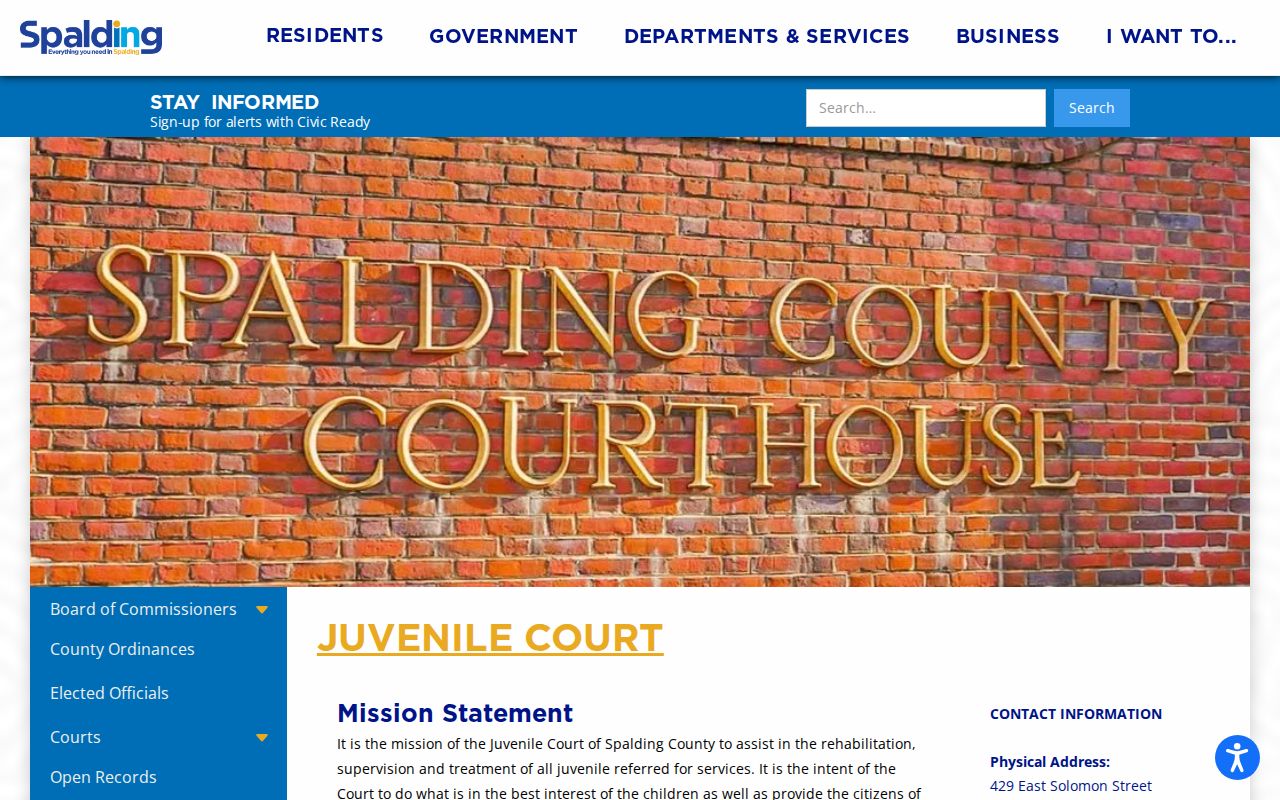
The court's separate page and location reflect a distinct record lane, not an extra filter inside the adult criminal portal.
Spalding Accountability Court Records
Spalding County also operates Veterans and Mental Health Treatment Court as an accountability-court program. Specialty treatment can create its own hearings, reviews, orders, and status events within the assigned case. A program calendar or staff page does not replace the official register. Search the underlying case in the court that holds it, then ask the clerk which public entries document participation.
The county's Accountability Court page identifies the local program and its focus.
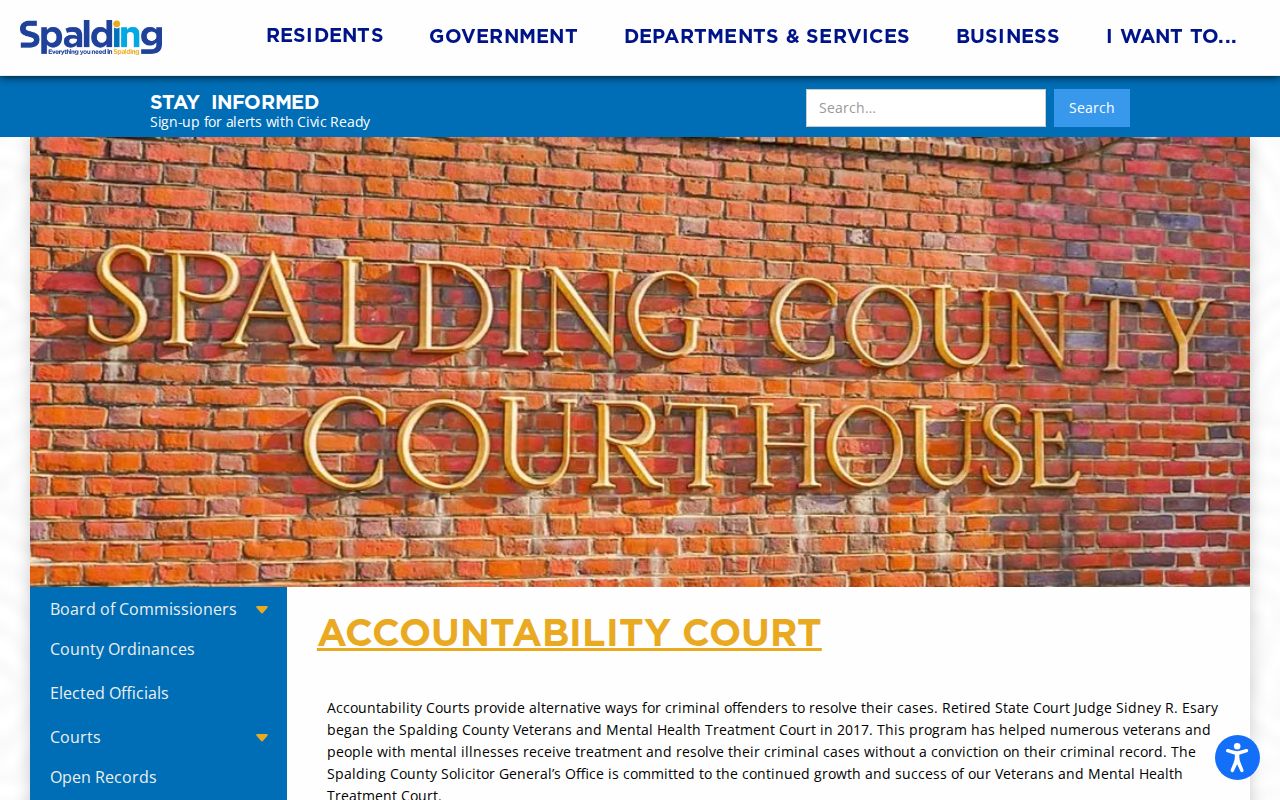
The program is a useful local route for understanding court supervision, but the originating criminal docket remains the source for filed events and orders.
Spalding Criminal Dockets and Police Records
A criminal court docket and a law-enforcement record answer different questions. The docket tracks the court case: charges filed with the court, appearances, motions, orders, settings, pleas, and disposition entries. An incident report, arrest record, jail record, or investigative file belongs to the agency that created it. The presence of an arrest record does not prove that a prosecutor filed a court case, and a court search that returns nothing does not prove that no police contact occurred.
Start with the desired fact. Use the criminal docket to confirm what the court received and what procedural events followed. Direct a properly framed Open Records request to the law-enforcement custodian when the need concerns an incident report or agency record. The Sheriff, Griffin Police Department, Georgia State Patrol, and other agencies can initiate matters that later reach State or Superior Court, but the issuing agency does not become the docket keeper.
Keep the records separate: an allegation, arrest, filed charge, hearing, and conviction are different events and must not be treated as synonyms.
Access Rules for Criminal Dockets
Georgia court records generally carry a presumption of public access, but that rule has limits. Juvenile matters, sealed records, protected personal identifiers, and other restricted materials may not appear in a public search. A public case number also does not guarantee access to every image. Role, account status, document security, and court orders can affect what is shown.
Key rules:
Georgia Open Records Act guidance applies to agency-held public records, but it does not override court orders or special confidentiality rules.
Georgia judicial-security guidance describes the process for restricting protected personally identifying information.
Use the originating court for the file itself. An Open Records request to law enforcement may reach an incident or arrest record, but it is not a shortcut around a sealed court filing. Never treat an accusation as fact or expose protected identifiers. When the public portal is incomplete, ask the clerk whether the entry is unavailable, restricted, or held in another court.